


Here’s a stat that’ll immediately show you why understanding digital marketing b2b vs b2c matters: 71% of B2B marketers prioritize lead generation while 58% of B2C marketers focus on customer experience. That’s not a minor difference it’s a completely different approach to how you allocate resources, measure success, and engage your audience.
In our experience working with businesses across both models, we’ve seen firsthand how this disconnect creates real challenges. You’re either nurturing long-term B2B relationships that span months or driving rapid B2C engagement that converts in minutes. The problem? Most businesses especially those serving both markets or transitioning between them struggle to balance these competing demands.
That’s where this guide comes in. We’re giving you the definitive 2025 framework for mastering both B2B marketing strategy and B2C marketing strategy. You’ll discover the 8 critical differences that transform how you target audiences, craft messages, select platforms, and measure ROI. Plus, we’re addressing what competitors miss: AI-driven solutions to attribution challenges and actionable frameworks for hybrid businesses. With content marketing projected to generate $107 billion by 2026, there’s never been a better time to get this right.
Understanding the Core Differences Between B2B and B2C Marketing
Let’s start with the basics: B2B vs B2C meaning. B2B (business-to-business) marketing targets companies and organizational decision-makers, while B2C (business-to-consumer) marketing targets individual consumers making personal purchases. Simple enough, right? But here’s where it gets interesting the differences between b2b and b2c marketing run far deeper than just who you’re selling to.
In B2B contexts, you’re not dealing with a single person making an impulse buy. According to comprehensive B2B marketing strategies from HubSpot, you’re navigating buying committees with 6-12 stakeholders across procurement, IT, C-suite, and end-users. Each person has different priorities, concerns, and approval authority. That complexity fundamentally changes everything about how you market.
For hybrid businesses serving both markets, this creates a real pain point. You can’t just copy-paste your B2C social campaign into a B2B LinkedIn strategy and expect results. The psychology, timeline, and decision-making process are completely different.
What Makes B2B Marketing Unique?
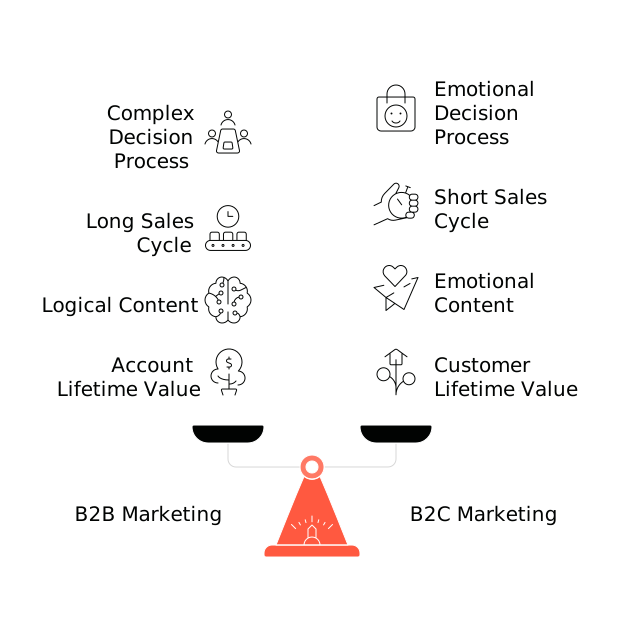
The B2B decision-making process is built on complexity and time. We’re talking about sales cycles that stretch 6-12 months with dozens of touchpoints before a single contract gets signed. Think about it: a company evaluating enterprise software isn’t making that call over lunch. They’re running vendor comparisons, ROI analyses, technical demos, and stakeholder alignment meetings.
This extended B2B sales cycle creates massive attribution challenges. When a deal closes after 47 touchpoints across email, webinars, trade shows, and sales calls, which channel gets credit? That’s why we focus on B2B marketing funnel metrics like pipeline influence rather than direct conversions.
The messaging reflects this rational approach. B2B buyers want proof points, case studies, whitepapers, and data-driven ROI calculations. They’re not buying on emotion they’re justifying budget expenditures to finance teams and demonstrating business value to executives. Every piece of content needs to support that logical, evidence-based decision journey.

How B2C Marketing Differs in Approach and Execution
B2C buyer behavior operates on a completely different timeline and psychology. We’re talking minutes to days, not months. Individual consumers make purchase decisions based on personal needs, emotional triggers, and immediate benefits. That impulse purchase on Instagram? It happened because the messaging hit an emotional chord, not because someone ran a 12-month ROI analysis.
The 58% of B2C marketers prioritizing customer experience (from our opening statistic) reflects this focus on immediate satisfaction and emotional engagement. B2C customer acquisition relies on creating desire, removing friction, and making the purchase process as seamless as possible.
B2C social media marketing thrives on storytelling, lifestyle imagery, and benefit-driven messaging. You’re not explaining technical specifications you’re showing how a product fits into someone’s life and makes them feel. Loyalty programs, referral incentives, and repeat purchase campaigns replace the long-term partnership approach of B2B.
The relationship is transactional by nature. While B2B focuses on lifetime account value and expansion, B2C optimizes for customer lifetime value through repeat purchases, upsells, and brand loyalty programs.
The 8 Critical Differences That Transform Your Marketing Strategy
Now we’re getting to the heart of what separates successful B2B marketing strategy from effective B2C marketing strategy. We’ve developed this B2B marketing strategy framework after working with businesses across both models, and it addresses what competitors miss: the complete picture of how these differences interact and compound.
Understanding these eight dimensions isn’t just academic it’s the difference between wasted budget on the wrong platforms and campaigns that actually drive revenue. Let’s break down each one with the specificity you need to make smart decisions.
Difference #1 - Target Audience Complexity and Decision-Making
Here’s where account-based marketing ABM becomes critical for B2B success. When you’re targeting niche decision-makers across a buying committee of 6-12 people, you can’t use broad demographic targeting like B2C campaigns. You need precision.
In our work with B2B clients, we’ve seen how buying committees include procurement (focused on cost), IT (concerned with security and integration), C-suite (evaluating business impact), and end-users (caring about usability). Each stakeholder needs different messaging at different funnel stages. That’s why ABM strategies focus on high-value accounts with personalized content for each decision-maker role.
Contrast that with B2C’s broad segmentation by demographics, psychographics, and behavior. You’re targeting thousands or millions of individual consumers who make independent purchase decisions. The complexity isn’t in committee dynamics it’s in scale and behavioral segmentation.
For B2B lead generation, platforms like LinkedIn lead generation strategies allow you to target by job title, company size, industry, and seniority. That precision targeting is what makes B2B campaigns work when you’re reaching a small pool of qualified decision-makers rather than a mass consumer audience.
| Difference | B2B Marketing | B2C Marketing |
|---|---|---|
| Target Audience & Decision-Making |
|
|
| Sales Cycle & Attribution |
|
|
| Messaging & Communication |
|
|
| Content Strategy & Formats |
|
|
| Platform & Channel Strategy |
|
|
| Relationship & Customer Lifecycle |
|
|
| AI & Personalization |
|
|
| Measurement & ROI Tracking |
|
|
Struggling to Align Your Digital Strategy with Audience Type?
Most brands apply one-size-fits-all marketing that misses both decision-makers and consumers. We design data-driven B2B and B2C digital strategies that speak directly to each audience — personalized journeys, optimized campaigns, and measurable ROI.
Actionable Framework for Hybrid Businesses B2B and B2C
Most businesses today don’t fit neatly into pure B2B or B2C models. You might sell enterprise software to companies while also offering consumer plans or be shifting between models. That’s why your digital marketing strategy must flex across both.
This framework helps hybrid businesses balance long-term B2B relationship nurturing with fast-paced B2C growth by aligning platforms, content, and measurement strategies.
When to Prioritize | B2B Marketing Tactics | B2C Marketing Tactics |
|---|---|---|
| Sales Model | High-value contracts ($10K+) with long sales cycles | High-volume, low-value transactions |
| Purchase Drivers | Logical, ROI-focused, multi-stakeholder decisions | Emotional, impulse-driven decisions |
| Cycle Length | Weeks to months; multiple touchpoints | Minutes to days; quick conversions |
| Customer Value | High LTV (5–10x initial purchase) | Moderate LTV; focus on repeat sales |
| Channels | LinkedIn, email nurture, webinars | Social media, ads, influencer marketing |
| Example Goal | Build trust, expand accounts | Boost immediate conversions |
For hybrid models, allocate resources based on both revenue share and growth potential, for example, a 60/40 split if B2B drives most revenue but B2C shows faster expansion. The tactics differ, but the principles stay the same: know your audience, deliver value, and measure what matters.

Suggested reading:
4 Types of Digital Marketing Explained: Choosing the Right Approach for B2B and B2C Success
Integrating B2B and B2C Strategies for Maximum Impact
While B2B and B2C marketing often look different, many tactics like SEO, content, and email work for both. The key lies in how you execute them.
LinkedIn builds authority and drives B2B leads, while Instagram fuels B2C engagement and brand connection.
Track performance separately, pipeline growth for B2B, direct conversions for B2C and tailor your messaging: insight-driven for businesses, emotionally resonant for consumers. The smartest brands balance both without losing a unified voice.
2026 Trends Reshaping B2B and B2C Digital Marketing
Digital marketing for both B2B and B2C is evolving fast and the lines between them are blurring. Short-form video, once a B2C favorite, is now a key B2B engagement tool. AI-powered personalization and privacy-first marketing are transforming how brands connect with audiences on both sides of the spectrum.

| Trend | How It Impacts B2B Marketing | How It Impacts B2C Marketing |
|---|---|---|
| AI & Predictive Analytics | Automates lead scoring, personalizes ABM content, and predicts conversion likelihoods. | Powers product recommendations, dynamic pricing, and proactive customer retention. |
| Short-Form Video Expansion | Thought-leadership videos, quick demos, and client testimonials on LinkedIn and YouTube Shorts. | Reels, TikToks, and user-generated videos driving engagement and brand loyalty. |
| Privacy-First Data Strategies | Gated content and progressive profiling build rich, compliant lead databases. | Loyalty programs and opt-in offers grow owned data and deepen customer trust. |
Not Sure if Your Campaigns Fit B2B or B2C Goals?
Mixing business and consumer tactics leads to wasted spend and inconsistent results. Our experts help you segment audiences, craft tailored messaging, and choose the right digital channels for each market — ensuring every campaign drives real growth.
Measuring Success: Key Takeaways for Your Marketing Strategy
Let’s bring this together. Understanding digital marketing b2b vs b2c differences isn’t academic it’s the foundation for smart budget allocation, platform selection, and campaign strategy. The 8 critical differences we’ve covered (audience complexity, sales cycles, messaging, content, platforms, relationships, AI, and measurement) compound to create completely different marketing approaches.
For B2B marketers, success means mastering long-term relationship nurturing, multi-stakeholder targeting, rational messaging, and pipeline influence metrics. For B2C marketers, it’s about rapid engagement, emotional storytelling, broad audience targeting, and direct conversion optimization.
Hybrid businesses face the biggest challenge and opportunity. By understanding both models, you can allocate resources effectively, choose the right platforms for each audience, and measure success appropriately. The framework we’ve provided addresses what competitors miss specific guidance for businesses operating in both models or transitioning between them.
The $107 billion content marketing opportunity is there for businesses that get this right. AI-powered personalization, short-form video expansion, and privacy-first strategies are reshaping both B2B and B2C marketing. Early adoption creates competitive advantages.
Action items for immediate implementation:
- Audit your current marketing mix are you using B2B tactics for B2C audiences (or vice versa)?
- Segment your measurement framework to track pipeline influence for B2B and direct conversions for B2C
- Test AI-powered personalization in your highest-value channel (ABM for B2B, product recommendations for B2C)
The businesses that thrive in 2025 and beyond will master both models, understanding when to prioritize relationship-building versus rapid engagement, technical depth versus emotional connection, and long-term nurturing versus immediate conversion.
Turn your digital presence into a conversion engine that connects with businesses and consumers alike. From content strategy to automation, we’ll help you build smarter, segmented campaigns that scale with your growth.
Frequently Asked Questions
What is the main difference between B2B and B2C digital marketing?
B2B targets businesses and multiple decision-makers with longer sales cycles and ROI-focused messaging. B2C targets individual consumers making quick, emotion-driven purchases. B2B thrives on LinkedIn and email, while B2C focuses on Instagram, TikTok, and direct conversions.
How should messaging differ between B2B and B2C campaigns?
B2B messaging should be logical, data-backed, and emphasize business value. B2C messaging should be emotional, relatable, and centered on personal benefits. Keep tone professional for B2B and conversational for B2C.
What marketing channels work best for B2B versus B2C?
B2B: LinkedIn, email, webinars, and industry blogs.
B2C: Instagram, TikTok, Facebook, and influencer marketing.
Hybrid brands can use LinkedIn for credibility and Instagram for reach and engagement.
What metrics matter most for measuring B2B marketing success?
B2B focuses on pipeline metrics – MQLs, SQLs, CAC, LTV, and deal velocity.
B2C tracks conversions, ROAS, and average order value.
B2B measures long-term influence; B2C measures immediate results.
How can hybrid businesses serve both B2B and B2C markets effectively?
Segment strategies clearly. Use shared tactics like SEO and email but tailor execution. Keep LinkedIn for B2B credibility, social media for B2C engagement, and measure pipeline vs. conversion results separately while maintaining consistent brand messaging.