


B2B marketing leaders are facing a perfect storm in 2025. Marketing budgets declined 15% in 2024 yet the pressure to prove ROI has never been more intense.
If you’re a CMO or marketing director at a mid-sized company, you know this challenge intimately: shrinking budgets, fragmented data across platforms, and leadership demanding measurable results.
But here’s what we’ve learned: budget constraints don’t have to mean performance decline.
Elite digital marketing strategists are turning these challenges into opportunities, using AI-powered, privacy-first frameworks to achieve remarkable results. We’re talking 92% year-over-year sales increases and 218% conversion improvements.
The transformation isn’t magic. It’s methodology.
We’ll show you exactly how modern digital marketing strategists build campaigns that deliver measurable revenue growth in 2025. You’ll discover the evolving role of strategists in an AI-driven world, learn data-driven frameworks for campaign optimization, master strategic channel selection, understand how to balance automation with authenticity, and find practical solutions to your most pressing challenges from proving ROI to managing fragmented tech stacks.
This isn’t theory. It’s the definitive playbook we use every day, built for the privacy-first, AI-powered reality of modern B2B marketing.
The Evolving Role of Digital Marketing Strategists
From Traditional Tactics to AI-Powered Strategic Leadership
The role of a digital marketing strategist has transformed dramatically over the past five years. In 2020, strategists were primarily channel specialists SEO experts, PPC managers, or content creators executing specific tactics. Today, they’re full-funnel architects who orchestrate AI-powered, privacy-first systems while balancing technology with human creativity.
So, what does a digital marketing strategist actually do today?
They’re no longer just executing campaigns!
They’re building intelligent systems.
We’ve seen this shift firsthand: over 70% of marketing strategies are now AI-powered, and 75% of brands are integrating generative AI for personalization. This means strategists now spend less time on manual execution and more time on strategic data interpretation and AI tool orchestration.
The skills evolution is real.
Modern strategists must understand how to prompt AI tools effectively, interpret complex attribution data, and make strategic decisions that algorithms can’t replicate.
They’re combining Phil Pallen’s insights on AI and branding integration with Avinash Kaushik’s analytics expertise to create campaigns that are both data-driven and authentically human.
What we’ve found is that the best strategists don’t fear AI but leverage it to amplify their strategic thinking. They use automation to handle repetitive tasks while focusing their creativity on brand storytelling, strategic positioning, and relationship building.
For a deeper look at how AI enhances customer interactions, check out our guide on how AI chatbots in customer support drive satisfaction.
The Privacy-First Imperative: Adapting to GDPR, CCPA, and Cookieless Attribution
Privacy regulations have fundamentally changed how we build campaigns.
GDPR and CCPA aren’t just legal requirements but are reshaping the entire data ecosystem that digital marketing relies on.
For B2B marketers, this means rethinking everything from lead capture to attribution modeling.
The shift from third-party cookies to first-party data strategies is no longer optional.
We’re helping clients build owned data ecosystems that respect privacy while maintaining personalization and attribution accuracy. This means creating value exchanges where prospects willingly share information because they’re getting something valuable in return whether that’s educational content, tools, or exclusive insights.
Here’s what works:
Transparent data practices that build trust rather than exploit it.
When you’re upfront about how you’ll use someone’s data and give them control over their preferences, conversion rates actually improve. We’ve seen companies increase form completions by making privacy policies clear and giving users granular consent options.
The technical challenge is real, though. Without third-party cookies, you need to build attribution systems that rely on first-party data, server-side tracking, and probabilistic modeling. This requires integrating your CRM with your marketing automation platform and web analytics to create a unified view of the customer journey. It’s complex, but it’s also more accurate and sustainable than cookie-based tracking ever was.

Suggested reading:
Digital Marketing Strategy Process: How to Plan, Execute, and Achieve B2B Marketing Goals
Building Data-Driven B2B Campaigns: From Strategy to Execution
Establishing Strategic Foundations: Goals, Personas, and Journey Mapping
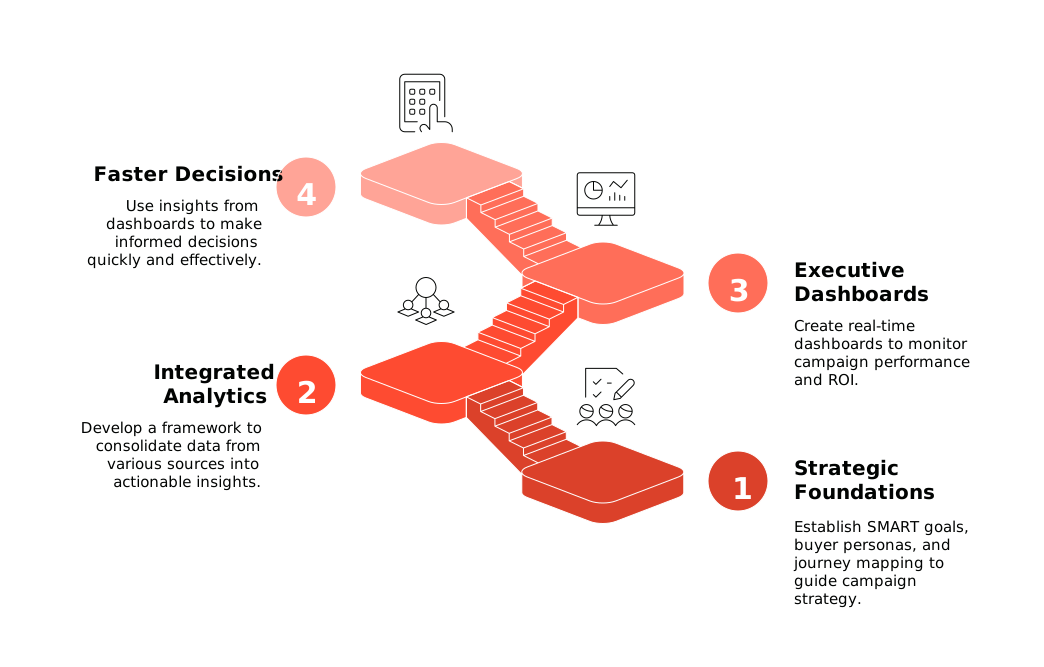
Every high-performing campaign starts with three foundational elements: clear goals, detailed buyer personas, and mapped customer journeys.
Skip these, and you’re building on sand.
SMART goals tied to revenue outcomes are non-negotiable.
We don’t just aim for “more traffic” or “better engagement” we set specific targets like “generate 150 marketing-qualified leads per month with a 25% sales-accepted rate” or “achieve $500K in pipeline contribution from content marketing by Q3.”
These goals connect directly to business objectives and give you clear metrics to track.
Buyer persona development for B2B is more complex than B2C because you’re dealing with buying committees, not individual consumers. Your personas need to account for multiple stakeholders the technical evaluator, the financial decision-maker, the end user, and the executive sponsor. Each has different pain points, information needs, and decision criteria.
We map the B2B buyer journey across three stages:
awareness (problem identification),
consideration (solution evaluation), and
decision (vendor selection)
But here’s what most marketers miss: the journey isn’t linear.
Decision-makers loop back, involve new stakeholders, and consume content across multiple channels before making a choice. Your campaign needs to support this complexity with content and touchpoints for every stage and stakeholder.
For a deeper dive into journey mapping methodology, read our guide on the importance of knowing your customer journey.
Integrated Analytics Frameworks: Turning Data Chaos into Actionable Insights
Data overload and fragmentation across platforms is one of the top pain points we hear from marketing leaders. You’ve got data in your CRM, advertising platforms, web analytics, social media tools, and marketing automation system but no single source of truth.
Building an integrated analytics framework solves this.
Here’s how we do it:
Step 1: Define Your Key Metrics
What actually matters to your business?
Focus on metrics tied to revenue: MQLs, SQLs, pipeline contribution, conversion rates by stage, CAC, and LTV.
Step 2: Map Data Sources
Identify where each metric lives.
Lead data might be in your CRM, ad performance in Google Ads and LinkedIn, website behavior in GA4, and email engagement in your marketing automation platform.
Step 3: Build Data Pipelines
Step 4: Create Executive Dashboards
Build dashboards that show the metrics that matter to leadership in real-time. We use tools like Google Data Studio, Tableau, or HubSpot‘s reporting features to visualize pipeline contribution, ROI by channel, and campaign performance.
The goal isn’t more data- it’s actionable insights.
Your dashboard should answer questions like “Which channels are driving the highest-quality leads?” and “What’s our current ROI on content marketing?”
If you can’t answer those questions quickly, your analytics framework needs work.
For more on using data to improve performance, explore our post on utilizing data-driven insights to enhance B2B website user experience.
Is your website designed for conversions or just clicks?
Discover what your users actually need through data-driven UX research, journey mapping, and usability testing. We transform insights into wireframes and experiences that drive engagement and deliver measurable ROI, not guesswork.
Strategic Channel Selection and Omnichannel Integration
Where to Allocate Budget for Maximum Impact
Not all marketing channels deliver equal ROI, and in 2025, the landscape has shifted faster than ever. Here’s how we help clients make smart budget allocation decisions.
The foundation channels for B2B remain strong:
- SEO for long-term organic visibility and authority building
- PPC (Google Ads, LinkedIn Ads) for targeted demand capture
- Content marketing for thought leadership and nurturing
- Email marketing for relationship building and conversion
But emerging channels are demanding attention. Voice search accounts for over 1 billion monthly searches , and social commerce is projected to exceed $1 trillion by 2028. These aren’t future trends but are current opportunities.
So which channels should receive budget priority in Q4-2025?
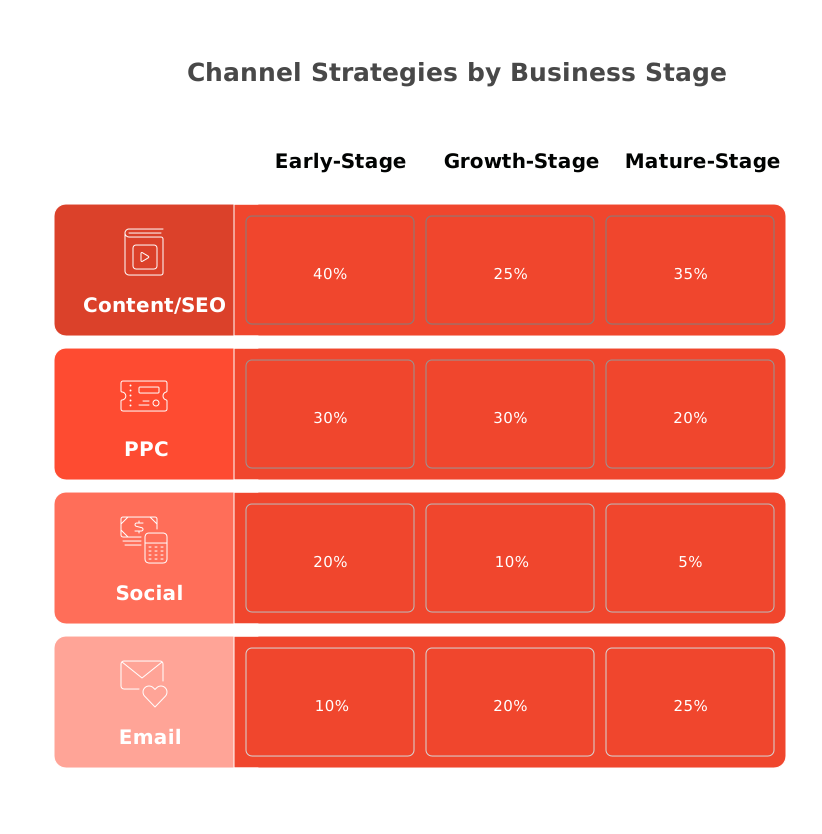
It depends on your business stage and goals:
Early-stage companies (building awareness):
Focus 40% on content marketing and SEO, 30% on targeted PPC, 20% on social media, 10% on email nurturing.
Growth-stage companies (scaling lead generation):
Allocate 30% to PPC, 25% to content marketing, 20% to email marketing, 15% to SEO, 10% to social media.
Mature companies (optimizing efficiency):
Invest 35% in SEO and organic, 25% in email and retention marketing, 20% in PPC, 15% in content, 5% in emerging channels for testing.
The key is maintaining flexibility.
We recommend reserving 10-15% of your budget for testing new channels and tactics.
That’s how you discover the next high-ROI opportunity before your competitors.
Building Seamless Omnichannel Experiences
Coordinating messaging across multiple channels consistently is one of the biggest challenges B2B marketers face. Your prospect might discover you through organic search, engage with your LinkedIn content, download a whitepaper, receive nurture emails, and attend a webinar all before ever talking to sales.
If those experiences feel disconnected, you’re losing opportunities.
Here’s our framework for building truly integrated omnichannel campaigns:
Unified Messaging with Channel-specific Tactics
Your core value proposition and brand voice should be consistent everywhere, but the format and approach should be optimized for each platform.
A LinkedIn post should feel native to LinkedIn, while an email should leverage the intimacy of the inbox.
Cross-channel Attribution and Measurement
Track how channels work together, not just individually.
We’ve found that prospects who engage across 3+ channels convert at 2-3x the rate of single-channel prospects.
Your measurement system needs to capture these synergies.
Consistent Brand Experience
Visual identity, tone of voice, and value proposition should be recognizable across every touchpoint.
When someone moves from your Instagram ad to your website to your email nurture sequence, it should feel like a coherent journey, not disconnected experiences.
Campaign Orchestration
Plan campaigns holistically. If you’re launching a new product, coordinate the announcement across email, social media, paid ads, PR, and content marketing simultaneously.
Each channel should reinforce the others.
The technical piece matters too.
Use marketing automation to trigger cross-channel sequences based on behavior.
If someone downloads a whitepaper, they should enter a nurture sequence that includes email, retargeting ads, and social media engagement, all coordinated to move them toward conversion.

Suggested reading:
Why The Role of Web Hosting in SEO Matters: How Hosting Affects Your Google Rankings
Emerging Channels: Voice Search, Social Commerce, and AI-Powered Discovery
The channels that will define the next three years are already here you just need to know how to leverage them. Voice search optimization is no longer optional. With voice search accounting for 1 billion+ monthly searches, you need to optimize for conversational queries and long-tail keywords.
Instead of targeting “B2B marketing software,” target “what’s the best marketing automation platform for small B2B companies?”
Voice searchers ask questions, so your content needs to provide answers.
Social commerce is exploding, projected to exceed $1 trillion by 2028.
For B2B, this means leveraging LinkedIn’s native commerce features, creating shoppable content, and reducing friction between discovery and conversion. The line between content and commerce is blurring.
AI-powered search engines (ChatGPT, Google Gemini, Perplexity) are changing how people discover information. To optimize for these platforms, focus on:
- Clear, authoritative content that directly answers questions
- Structured data and schema markup
- Building topical authority in your niche
- Citations and credible sources that AI can reference
We’re already seeing traffic shifts. Some are getting 15-20% of their organic traffic from AI-powered search tools. That percentage will only grow.
For specific tactics on voice search optimization, read our guide on 2025 SEO for voice search best practices.
Balancing AI Automation with Human Creativity and Authenticity
The AI Advantage: Automation, Personalization, and Predictive Analytics
AI isn’t replacing marketers it’s amplifying what the best marketers can do. We’ve seen this transformation firsthand, and the numbers back it up: 70% of marketing strategies are AI-powered, and 75% of brands integrate generative AI for personalization.
Here’s where AI delivers the biggest impact:
Marketing Automation at Scale
AI handles repetitive tasks like email sequencing, lead scoring, and ad bid optimization. This frees up your team to focus on strategy and creativity. We’ve helped clients reduce manual campaign management time by 60% while improving performance by 40%.
Hyper-personalization
AI analyzes behavioral data to deliver personalized content, product recommendations, and messaging to each prospect. Instead of one-size-fits-all nurture sequences, you can create dynamic experiences that adapt based on engagement, industry, role, and stage.
Predictive Analytics
AI identifies patterns in your data to predict which leads are most likely to convert, which customers are at risk of churn, and which campaigns will deliver the best ROI. This turns marketing from reactive to proactive.
Content Generation and Optimization
AI assists with content creation, from generating blog outlines to writing ad variations to optimizing email subject lines. It’s not about replacing human writers it’s about giving them a starting point and handling variations at scale.
For specific AI workflows that work, check out these 5 AI-powered workflows every SEO should be using today.
The efficiency gain is real.
With smaller budgets, AI lets you do more. Leading to possibilities where businesses cut their content production time in half while doubling output quality by using AI for research, outlining, and first drafts, then having human writers refine and add strategic insights.
Stop manually chasing leads. Start converting them automatically.
Marketing automation transforms how you nurture prospects—from first touch to closed deal. We build intelligent systems that deliver personalized content at scale, score leads based on behavior, and feed sales teams only the hottest opportunities.
Maintaining Authenticity: The Human Touch in an AI-Driven World
Here’s the tension every marketer faces:
AI makes you more efficient, but audiences crave authenticity.
How do you balance automation with human creativity?
Our framework is simple:
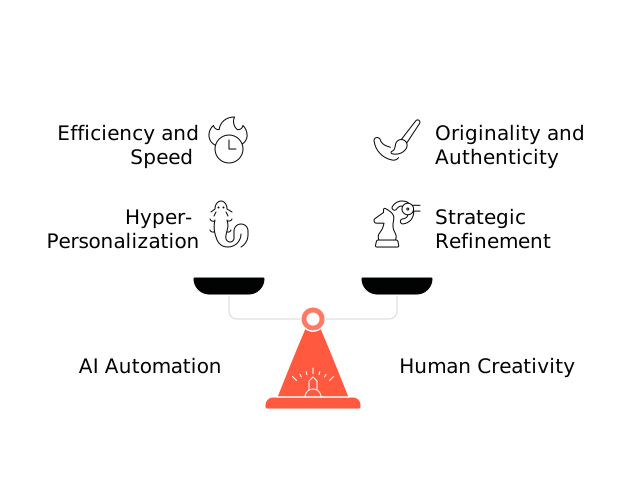
AI handles repetitive tasks, humans handle strategy and creativity.
| Where AI Excels | Where Humans Remain Irreplaceable |
|---|---|
| Data Analysis and Pattern Recognition | Strategic Vision and Positioning |
| Content Variations and A/B Testing | Brand Storytelling and Voice |
| Repetitive Task Automation | Ethical Judgment and Empathy |
| Personalization at Scale | Relationship Building |
| Predictive Modeling | Creative Breakthroughs |
The best campaigns we’ve seen use AI to generate dozens of ad variations, then have human strategists select the most compelling messages and refine the brand voice.
AI provides the raw material; humans provide the judgment and creativity.
Storytelling is a perfect example.
AI can help you structure a narrative or generate supporting content, but the emotional core of your brand story needs human insight. For B2B audiences especially, emotional connection drives decision-making. This resource on how storytelling can build an emotional connection with a B2B audience breaks down why this matters and how to do it well.
The key is transparency.
Don’t try to pass off AI-generated content as purely human-created.
Your audience is smart they can tell.
Instead, use AI as a tool that enhances your human expertise, not replaces it.
Ethical AI Use and Transparency in Marketing
As AI becomes more prevalent, ethical considerations become more important.
Here’s how we approach responsible AI use:
Transparency about AI-generated Content
When appropriate, disclose that content was created with AI assistance. This builds trust and sets realistic expectations.
Bias Mitigation
AI models can perpetuate biases present in their training data. Regularly audit your AI-powered targeting, personalization, and content generation for bias. Ensure you’re not inadvertently excluding or stereotyping segments of your audience.
Privacy-first Data Practices
AI requires data, but that doesn’t mean you should collect everything you can. Follow privacy regulations, get proper consent, and be transparent about how you use customer data in AI systems.
Human Oversight
Never let AI make important decisions without human review. Use AI to inform decisions, not make them autonomously.
Ethical AI use isn’t just good practice, it’s good business.
Companies that build trust through responsible AI practices see higher customer loyalty and better long-term performance.

Suggested reading:
CRM Marketing Automation: A Complete Guide to Streamline Your Sales and Marketing
Keeping Pace with Rapid Technology and Algorithm Changes
Technology and algorithms change constantly. Google updates its algorithm hundreds of times per year. Social media platforms change their features and algorithms monthly.
New AI tools launch weekly.
How do you keep pace?
Build A Continuous Learning Culture
Make learning part of your team’s regular workflow.
We dedicate 2-4 hours per week to reading industry publications, testing new tools, and attending webinars.
Follow Trusted Sources
Don’t try to consume everything.
Identify 5-10 trusted industry sources (like Search Engine Journal, Moz, Content Marketing Institute, MarketingProfs) and follow them consistently.
Create A Testing Budget
Reserve 10-15% of your budget for experimentation.
This lets you test new channels, tactics, and tools without jeopardizing core performance.
Adopt Agile Marketing Methodology
Work in sprints, review performance frequently, and adapt quickly.
Instead of annual planning with rigid execution, plan quarterly and optimize weekly.
Join Expert Networks
Invest in Certifications and Training
Platforms like Google, HubSpot, and Facebook offer free certification programs that keep you current on platform changes and best practices.
The key mindset shift: view change as opportunity, not threat.
When Google updates its algorithm, most marketers panic.
The best marketers see it as a chance to gain competitive advantage by adapting faster than their competitors.
Stop worrying about server crashes during peak traffic.
Enterprise cloud hosting built for growth.
Auto-scaling resources, redundant backups, and 24/7 monitoring ensure your site performs flawlessly at any scale.
Building Resilient, Future-Proof Marketing Strategies
Here’s what we’ve learned after helping hundreds of B2B companies navigate constant change: the most resilient marketing strategies are built on timeless principles, not tactical trends.
Deep customer understanding never goes out of style. Technology changes, channels emerge and fade, but knowing your customer’s pain points, decision criteria, and buying process remains foundational. Invest in customer research, persona development, and journey mapping. These insights inform every tactical decision.
Value creation over promotion. The best marketing doesn’t feel like marketing it feels like valuable content, useful tools, or helpful insights. Build assets that genuinely help your audience solve problems, and distribution becomes easier.
Measurement discipline. Track what matters, measure consistently, and make data-driven decisions. Companies with strong analytics cultures adapt faster because they see what’s working (and what’s not) in real-time.
Strategic consistency with tactical flexibility. Your core positioning, value proposition, and brand identity should remain consistent. But your tactics the specific channels, campaigns, and tools you use should evolve constantly based on performance and opportunity.
Build owned assets. First-party data, content libraries, email lists, and brand authority compound over time. Rented assets (like social media followers or paid traffic) can disappear overnight. Balance both, but prioritize building what you own.
Create a testing culture. The best predictor of future success is your ability to test, learn, and adapt. Make experimentation part of your DNA, not a special project.
Continuous optimization as core practice. Marketing isn’t a “set it and forget it” activity. The best performers review performance weekly, optimize constantly, and never assume yesterday’s winning formula will work tomorrow.
This framework helps navigate algorithm updates, platform changes, economic downturns, and technology disruptions.
The transformation we’re seeing in B2B digital marketing is real and accelerating. Strategists have evolved from tactical executors to AI-powered, privacy-first campaign architects who balance technology with human creativity. The frameworks we’ve shared from multi-touch attribution to integrated analytics to omnichannel orchestration aren’t theoretical. They’re the exact systems we use to turn budget constraints and data chaos into measurable revenue growth.
The proof is in the results: 92-218% performance increases are achievable when you combine strategic discipline with the right frameworks and tools.
But here’s what matters most:
the competitive advantage in 2025 doesn’t go to companies with the biggest budgets or the most tools.
It goes to those who master the balance of technology and humanity, data and creativity, efficiency and value. Those who build privacy-first systems that respect customers while delivering personalization.
Those who leverage AI for scale while maintaining authentic brand voices. Those who prove marketing value with rigorous attribution while telling compelling stories. The future of B2B marketing belongs to strategists who can orchestrate this complexity , and you now have the blueprint to be one of them!
Work with strategists who speak the language of revenue, not just clicks.
We leverage data, attribution modeling, and intelligent automation to create campaigns that drive pipeline and prove ROI.

Frequently Asked Questions
What does a digital marketing strategist do in 2025?
A digital marketing strategist orchestrates AI-powered, privacy-first marketing systems. They focus on strategic data interpretation, multi-touch attribution modeling, customer journey mapping, and cross-functional collaboration—spending less time on manual execution and more on strategic decision-making that drives business growth.
How do I prove marketing ROI with complex multi-touch attribution?
Implement a W-shaped or algorithmic attribution model and build executive dashboards that track pipeline contribution, customer acquisition cost, lifetime value, and ROI by channel. Use your CRM to connect marketing touchpoints to closed deals and present results in revenue terms leadership cares about.
What are the best attribution models for B2B companies with long sales cycles?
W-shaped or algorithmic attribution models work best. W-shaped credits first touch, lead creation, and opportunity creation. Algorithmic uses machine learning to assign credit based on actual touchpoint influence. Both capture the full journey better than first-touch or last-touch models.
How can I balance AI automation with human creativity in my marketing campaigns?
Use AI for repetitive tasks—content variations, A/B testing, data analysis, and personalization at scale. Reserve strategic vision, brand storytelling, ethical judgment, and creative breakthroughs for humans. AI enhances expertise; it doesn’t replace it.
Which digital marketing channels should receive budget priority in 2025?
It depends on your stage.
Early-stage: content/SEO (40%), PPC (30%), social (20%), email (10%).
Growth-stage: PPC (30%), content (25%), email (20%), SEO (15%), social (10%).
Mature: SEO/organic (35%), email/retention (25%), PPC (20%), content (15%), testing (5%). Always reserve 10-15% for experimenting with new channels.